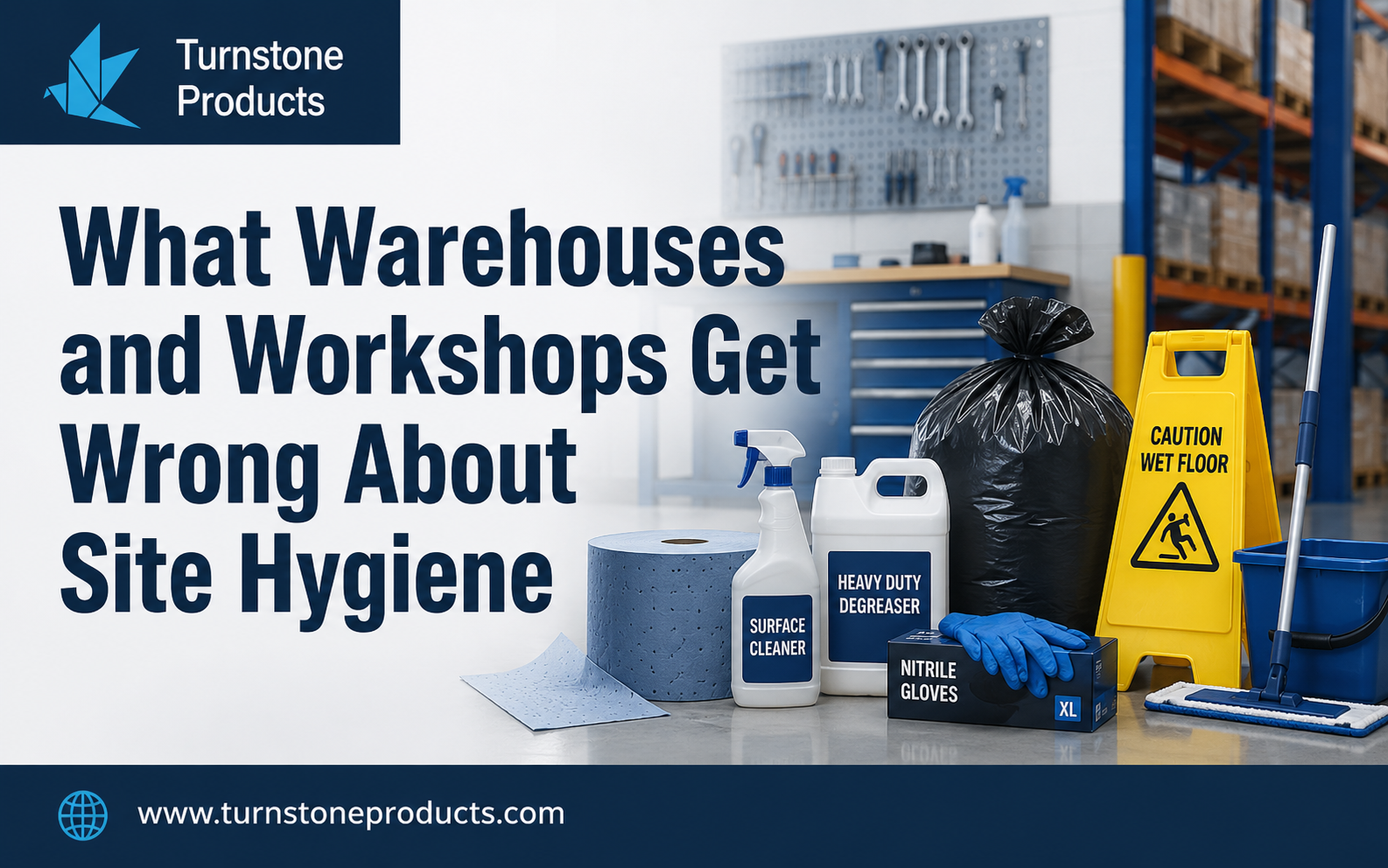
Walk into most warehouses and workshops and you’ll see serious money spent on safety — racking inspections, forklift servicing, machine guarding, high-vis everywhere. Then look at the hygiene setup: a single grimy sink, a retail bottle of degreaser someone bought months ago, paper towel that ran out last Tuesday. Industrial sites treat hygiene as an afterthought, and it costs them in ways that never get attributed correctly — lost hours, damaged goods, failed audits and avoidable injuries.
The frustrating part is that industrial hygiene is cheap to fix. It doesn’t require consultants or capital works — it requires the right consumables, in the right grade, actually stocked. Sites that source proper cleaning products perth suppliers stock for industrial environments — heavy-duty chemicals, jumbo wipe-up rolls, industrial hand cleaners, correct PPE — spend surprisingly little and get measurable returns. This article covers the mistakes almost every industrial site makes, and the straightforward fixes.
Mistake 1: Using Office-Grade Products in an Industrial Environment
The most common error is buying hygiene products as if the site were an office. It isn’t. Grease, swarf, dust, oils and chemical residues defeat general-purpose products instantly.
Where the Mismatch Shows Up
- Hand cleaning — ordinary soap doesn’t shift grease and oil. Workers either scrub with solvents (a skin-damage problem) or give up (a contamination problem). Industrial-grade grit hand cleaners exist precisely for this.
- Wipe-up — standard kitchen towel disintegrates on oil spills. Jumbo blue industrial rolls are engineered for exactly that job and cost less per clean-up, not more.
- Surface chemicals — a light spray-and-wipe won’t cut workshop grime, so staff use triple the product for half the result. Heavy-duty degreasers in bulk drums do it in one pass.
The fix is simple: audit each cleaning task and match the product grade to it. Industrial-grade consumables aren’t a luxury tier — they’re the correct tool.
Mistake 2: Treating Spill Response as Improvisation
In workshops, spills aren’t an if — they’re a when. Oil, coolant, chemicals, water tracked in from the yard. Yet most sites have no defined spill kit and no wipe-up station; whoever’s nearest grabs whatever’s around.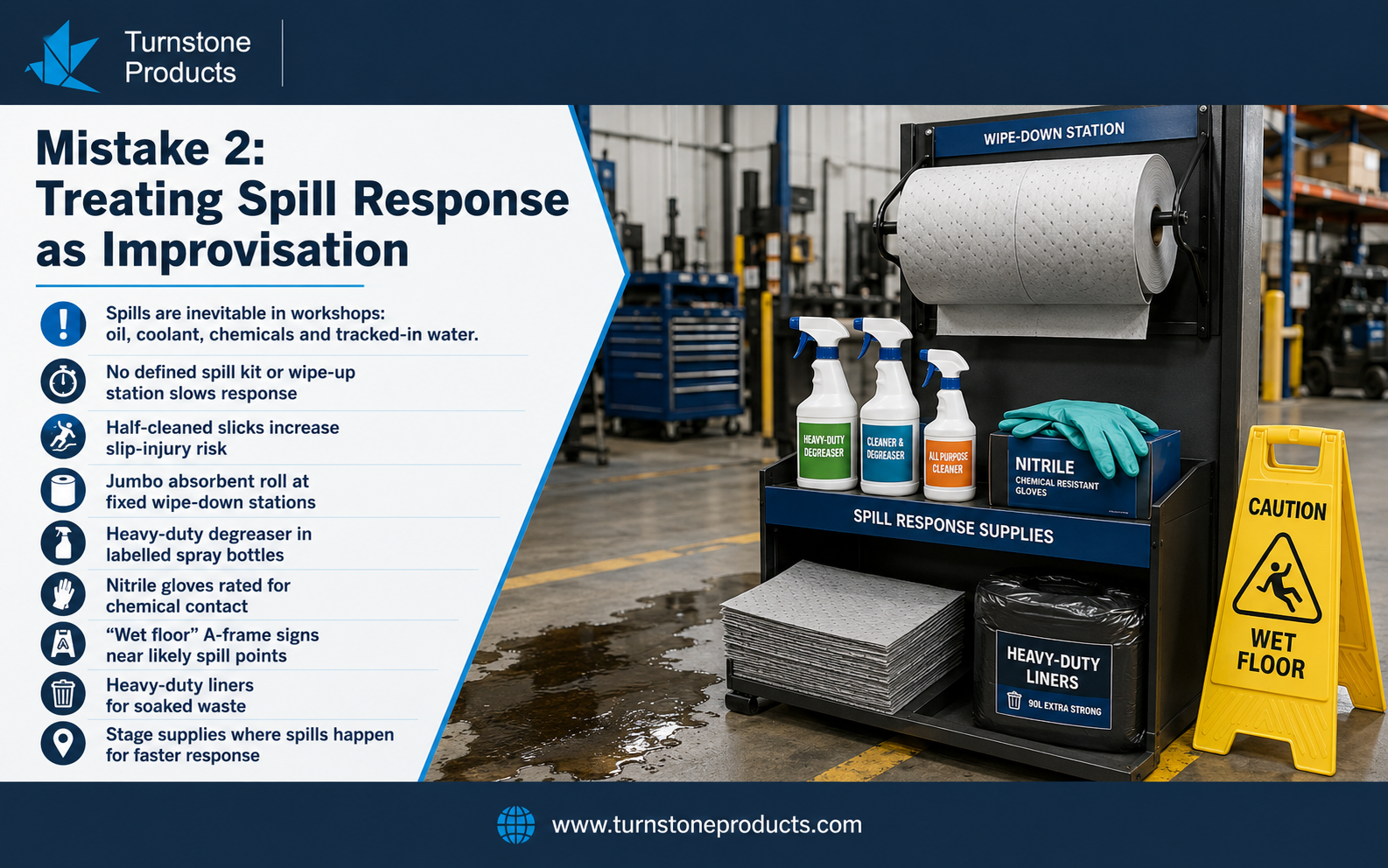
That improvisation has real costs. A slick left half-cleaned is a slip injury waiting to happen — and slips remain among the most common workplace injury claims in Australian industrial settings. A proper response setup is trivially cheap by comparison:
- Jumbo absorbent roll mounted at fixed wipe-down stations
- Heavy-duty degreaser, correctly diluted, in labelled spray bottles
- Nitrile gloves rated for chemical contact (not bare hands, not thin vinyl)
- “Wet floor” A-frame signs staged where spills actually happen
- Heavy-duty liners so soaked waste is bagged once, without splitting
Position these at the points of likely spills, not locked in a distant store, and response time drops from minutes to seconds.
Mistake 3: Underestimating Amenities — and What They Signal
Workshop lunchrooms and washrooms are routinely the worst-kept spaces on site, and managers underestimate what that costs. Staff notice. Visitors notice. Auditors definitely notice. A washroom with no soap and an empty towel dispenser tells everyone on site exactly how much hygiene actually matters here — and behaviour follows that signal.
Getting amenities right in an industrial context means acknowledging traffic and grime levels are higher than an office. When sourcing commercial cleaning products perth wide, industrial operators should spec accordingly: jumbo toilet rolls that don’t run out between services, durable centre-pull or slimline towel systems, soap that actually removes what’s on workers’ hands, and bins with liners strong enough for workshop waste. None of this is exotic — it’s just sized for reality instead of copied from an office supply list.
The Contamination Angle
For sites handling goods — warehousing, food-adjacent storage, assembly — poor hand hygiene isn’t only a welfare issue. Grease and grime transfer to stock, packaging and paperwork. Clean hands are product protection.
Mistake 4: Buying Retail, Ad Hoc, at the Worst Prices
Industrial consumables get consumed fast — that’s the point. Which makes ad hoc retail buying uniquely wasteful here. Sites burn through wipe-up roll, gloves and degreaser at volumes that scream for carton and drum pricing, yet keep buying single units because nobody owns the purchasing.
The trade-supply model fixes this in one move:
- Buy chemicals in 5L–20L drums and decant — the per-litre saving over retail bottles is dramatic at workshop consumption rates.
- Buy gloves and wipes by the carton, not the box.
- Put it on a standing order. Usage in industrial settings is predictable; a recurring fortnightly delivery means the storeroom never runs dry and nobody leaves site to shop.
- Consolidate to one supplier so the whole list lands in one delivery, one invoice, one price conversation.
For a mid-sized workshop, that switch typically pays for itself within the first order cycle.
Mistake 5: No Owner, No System
Ask who’s responsible for hygiene consumables on most industrial sites and you’ll get a shrug. Safety has an owner; quality has an owner; the hand cleaner runs out and it’s nobody’s job. The final fix is organisational: nominate one person, give them a standard product list, a reorder trigger and a supplier relationship. Twenty minutes a fortnight, and the entire problem class disappears.
Why Choose Turnstone Products
Turnstone Products is a Perth-based B2B supplier that stocks the industrial end of the hygiene spectrum properly — heavy-duty cleaning chemicals in bulk drums, Grease Off industrial hand cleaner, jumbo blue wipe-up rolls, nitrile gloves, PPE, safety signage and heavy-duty bin liners — alongside all the amenities consumables a site needs. As a supplier of industrial cleaning supplies perth workshops and warehouses rely on, Turnstone runs a trade model built for industrial buying: order by quote or phone, get carton and drum pricing matched to your actual consumption, and receive next-day delivery across the Perth metro so a busy site never runs short. Set up a trade account with a standing order and the “nobody owns it” problem is solved permanently.
The Bottom Line
Industrial sites don’t have a hygiene spending problem — they have a hygiene system problem. Wrong-grade products, improvised spill response, neglected amenities, retail buying and no ownership. Every one of those is fixable this month with correct-grade consumables, staged supplies, trade pricing and a standing order. The sites that get this right don’t spend more; they just stop wasting what they were already spending — and pick up fewer injuries, cleaner audits and better morale along the way.